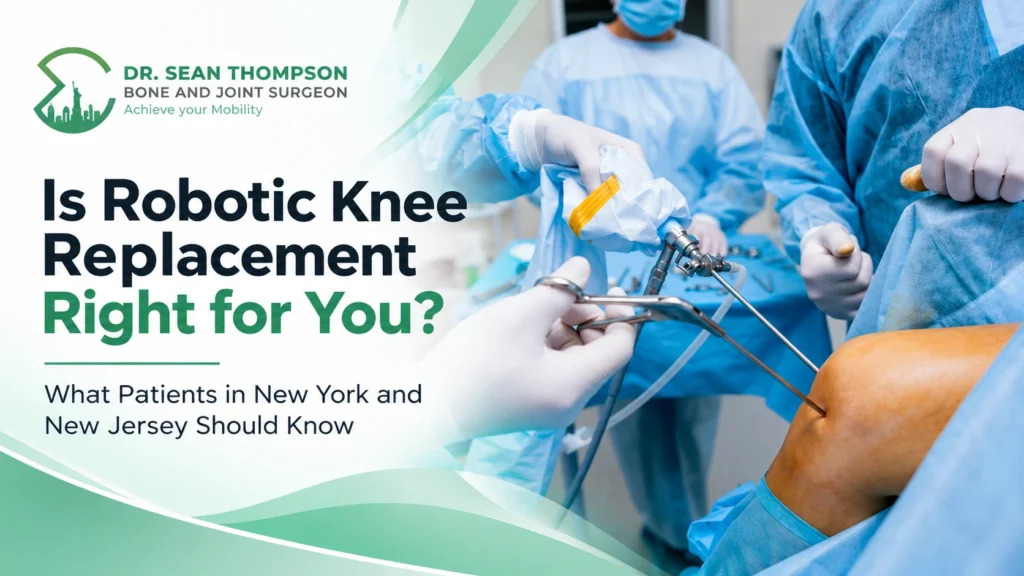
By the time many patients come in for a knee consultation, they have already read about robotic knee replacement. Some arrive convinced it is the only option worth considering. Others are uneasy about the idea of a machine being involved in their surgery at all.
Both reactions are understandable, and neither tells the whole story. Robotic-assisted knee replacement is a tool. In the right hands and for the right patient, it can help a surgeon plan and carry out a knee replacement with a high degree of precision. But it does not replace the surgeon; it does not make surgery risk-free, and it is not the right choice for everyone.
This guide explains how robotic knee replacement works, who tends to benefit, what recovery really looks like, and what to ask before you decide. It draws on the experience of Sean Thompson, MD, a board-certified orthopedic surgeon who has focused on hip and knee replacement for more than 17 years and has performed more than 2,000 knee replacements. Dr Thompson performs robotic-assisted total knee replacement using the Mako system at Northwell Health and sees patients in Manhattan, Queens, Englewood, and Clifton.
Key takeaways
- A robot does not perform your surgery. Your orthopedic surgeon does, using robotic technology to help plan and guide specific steps.
- The most important decision comes before the technology: whether your knee actually needs to be replaced.
- Robotic assistance can help with implant positioning and balancing the ligaments around the knee, but it does not guarantee a faster recovery or a better result for every patient.
- Recovery after robotic and conventional knee replacement is broadly similar. Your effort in physical therapy matters a great deal.
- The surgeon’s training and experience with knee replacement matter more than the brand of robot.
Start with the right question: Do you need a knee replacement?
Before discussing robots, it is worth stepping back. The first question is not “robotic or traditional?” It is “Is surgery the right next step for my knee?”
Knee replacement is usually considered when arthritis or joint damage causes pain and stiffness that limit daily life, and when nonsurgical treatment has stopped helping. Signs that it may be time for an evaluation include:
- Knee pain that interferes with walking, sleeping, working, or climbing stairs
- Stiffness that makes it hard to fully bend or straighten the knee
- Swelling that keeps coming back
- A knee that feels unstable or gives way
- Pain that continues despite physical therapy, medication, injections, weight management, or activity changes
- X-rays showing significant cartilage loss or bone changes from arthritis
Many people with knee pain never need surgery. Physical therapy, bracing, medications, injections, and activity changes can provide meaningful relief, especially in earlier stages of arthritis. A thorough evaluation should look at all of these options, not only surgical ones.

What is robotic knee replacement?
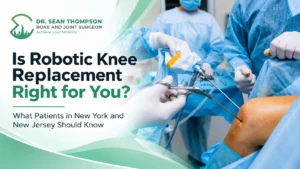
Robotic-assisted knee replacement uses computer software and a robotic arm to help your surgeon plan and perform the operation. Dr. Thompson uses the Mako robotic-arm system, which starts with a CT scan of your knee taken before surgery. That scan is used to build a detailed 3D model of your joint.
During surgery, that map helps the surgeon:
- Measure the shape and alignment of your knee
- Plan exactly where the bone cuts and implants should go
- Check how tight or loose the ligaments are as the knee bends and straightens
- Stay within planned boundaries while preparing the bone
The surgeon makes the incision, makes the clinical decisions, and can adjust or override the plan at any point. The robot does not move on its own or operate independently.
Dr. Thompson uses robotic assistance for total knee replacement, in which all three compartments of the knee are resurfaced with new implants.
Where the technology helps most: balancing the knee
A knee replacement is not only about replacing worn cartilage with metal and plastic. A knee that feels natural depends on two things working together: how the implants are aligned, and how well the surrounding ligaments are balanced.
If the ligaments are too tight, the knee can feel stiff. If they are too loose, it can feel unstable. Arthritis often makes this harder, because years of joint damage can gradually pull the knee into a bowlegged or knock-kneed position and stretch or shorten the ligaments around it.
This is an area Dr. Thompson studied long before robotic systems became common in operating rooms. In 2011, he presented research at the American Academy of Orthopaedic Surgeons (AAOS) annual meeting on computer-assisted surgery and patterns of ligament deformity in the knee, based on a clinical and cadaveric study. That work focused on the same challenge today’s robotic systems are designed to address: understanding how a deformed knee behaves so it can be rebuilt in a balanced way.
For patients with significant deformity, the detailed measurements robotic systems provide can be especially useful during surgical planning. Even so, those measurements still need to be interpreted by an experienced surgeon.
When does Dr. Thompson recommend robotic surgery?
Not every knee replacement needs to be robotic. For Dr. Thompson, the decision comes down to careful patient selection.
“It comes down to patient selection. I base the decision on each patient’s anatomical and structural needs. When a knee has significant alignment problems or instability, robotic surgery may be the better option.” — Sean Thompson, MD
In practical terms, this means two things:
- Alignment problems. Arthritis can gradually pull the knee into a bowlegged or knock-kneed position. The more a knee has drifted out of alignment, the more helpful a detailed robotic plan can be in restoring it.
- Instability. When the ligaments around the knee are stretched, tight, or uneven, the knee may feel loose or give way. Robotic measurements during surgery can help Dr. Thompson balance these ligaments so the new knee feels stable.
If your knee is reasonably well aligned and stable, a conventional knee replacement may serve you just as well. Dr Thompson will explain which approach he recommends for your knee and why.
What to expect, step by step
- Consultation and evaluation. Your visit begins with a conversation about your symptoms, activity level, medical history, and the treatments you have already tried. Dr. Thompson will examine your knee and review X-rays to understand the extent of the damage.
- Deciding on a treatment plan. If surgery is appropriate, Dr. Thompson will explain whether robotic-assisted or conventional total knee replacement is the better fit, based on your knee’s alignment, stability, and overall structure.
- Preoperative planning. For Mako robotic-assisted surgery, you will have a CT scan of your knee before the operation. Dr. Thompson uses the resulting 3D model to plan implant size, position, and alignment.
- Surgery. Robotic-assisted surgery takes place at Northwell Health. Dr. Thompson removes the damaged cartilage and bone, using the Mako system to guide specific steps according to the plan, then places and tests the implants for alignment, stability, and range of motion.
- Recovery and rehabilitation. Most patients start walking with assistance soon after surgery. Physical therapy begins quickly and continues for several weeks to months.
What are the potential benefiits?
Research on robotic knee replacement is still evolving, and results vary by patient and system. Potential advantages for appropriately selected patients may include:
- A plan built around your anatomy. Implant size and position can be planned using measurements of your own knee.
- Consistent implant positioning. Robotic guidance can help the surgeon match the planned bone cuts and implant placement closely.
- Real-time ligament feedback. Some systems measure ligament tension during surgery, which can help with balancing the knee.
- Bone and soft-tissue preservation. Planned boundaries can help limit unnecessary disruption to surrounding tissue.
It is important to be clear about what robotic assistance cannot promise. It does not guarantee less pain, a faster recovery, a longer-lasting implant, or a better outcome for every patient. Many patients do extremely well with conventional knee replacement performed by an experienced surgeon.
Robotic vs. traditional knee replacement
Both approaches share the same goal: relieving pain and restoring function in a damaged knee. The main difference is how certain steps are planned and guided.
| Key Differences | Robotic-assisted knee replacement | Conventional knee replacement |
| Who performs the surgery | Orthopedic surgeon | Orthopedic surgeon |
| Planning | 3D model of your knee built from a CT scan (Mako system) | X-rays and standard measurement guides |
| Bone preparation | Guided by the robotic system within planned boundaries | Guided by conventional instruments and cutting guides |
| Ligament balancing | Can be measured with real-time data on some systems | Assessed by the surgeon’s hands-on evaluation |
| Recovery | Generally similar | Generally similar |
| Best fit | Depends on your anatomy, diagnosis, and surgeon’s judgment | Depends on your anatomy, diagnosis, and surgeon’s judgment |
The better question is not which technique is superior in general, but which approach makes the most sense for your knee.
Who is a good candidate fior robotic knee replacement?
Many patients who are candidates for knee replacement can also be considered for robotic assistance. Factors that may influence the decision include:
- Alignment and instability. Knees that have shifted into a bowlegged or knock-kneed position, or that feel loose and unstable, are where Dr. Thompson finds robotic planning most helpful.
- Prior surgery or hardware. Previous fractures, surgeries, or metal implants near the knee can affect planning and imaging.
- Overall health. Heart, lung, and other medical conditions affect surgical risk regardless of technique.
- Body weight. Higher body weight does not automatically rule out knee replacement, but it can affect surgical planning, risk, and recovery. Dr. Thompson has presented research at national meetings on joint replacement in patients with obesity, including complication patterns after total joint replacement, and takes these factors into account when building a plan.
Age alone usually does not decide candidacy. What matters most is how much the knee limits your life, what imaging shows, and whether surgery is likely to help you reach your goals.
What does recovery look like?
Recovery after robotic-assisted knee replacement is generally similar to recovery after conventional knee replacement. The technology may help with precision in the operating room, but recovery still depends on your health, your preoperative strength and mobility, and how consistently you follow your rehabilitation plan.
Dr. Thompson brings an unusual perspective to this part of the process. Before medical school, he spent several years working as a physical therapy assistant in Los Angeles, guiding patients through range-of-motion exercises and home exercise programs. That early experience shaped his view that what happens after surgery matters just as much as what happens during it.
A typical recovery timeline looks like this, though every patient’s progress is different:
First few days. Most patients stand and walk with a walker or other support soon after surgery, when medically appropriate. A physical therapist begins gentle exercises to improve circulation, knee motion, and strength.
Weeks 1 to 6. Walking distance and independence gradually increase. Many patients move from a walker to a cane during this period. Regular physical therapy focuses on bending and straightening the knee and strengthening the thigh muscles.
Weeks 6 to 12. Many patients notice clear improvements in walking and daily activities. Some swelling, stiffness, and fatigue are still common, especially at the end of the day.
3 to 12 months. Strength, endurance, and confidence continue to improve. Some patients notice gradual gains for up to a year after surgery.

Call your care team promptly if you notice:
- Fever, increasing redness, warmth, or drainage from the incision
- Sudden or worsening pain
- Calf pain, tenderness, or swelling
- Shortness of breath or chest pain (call 911)
What are the risks?
Robotic-assisted knee replacement is major surgery and carries the same general risks as conventional knee replacement, including:
- Infection
- Blood clots
- Bleeding
- Stiffness or limited range of motion
- Persistent pain
- Nerve or blood vessel injury
- Implant loosening or wear over time
- Anesthesia-related complications
- The possible need for additional surgery in the future
Robotic technology does not eliminate these risks. Sharing your full medical history, medications, allergies, and previous surgeries during your consultation helps your surgeon prepare a safer plan. Following preoperative and postoperative instructions carefully also plays an important role.
Questions to ask befiore your knee replacement
Bring these questions to your consultation, whether you see Dr. Thompson or another surgeon:
- Have I tried all the reasonable nonsurgical options for my knee?
- Is my knee’s alignment or stability a reason to consider robotic assistance?
- Would robotic assistance help in my case, and why?
- Which robotic system do you use, and how often do you use it?
- How many knee replacements do you perform each year?
- Which hospital will my surgery take place in?
- What will my first two weeks at home look like, and what help will I need?
- What results can I realistically expect for my activity level and goals?
A good surgeon will welcome these questions and answer them clearly.
How to choose a knee replacement surgeon in NYC and New Jersey
The robotic system matters far less than the surgeon using it. When comparing knee replacement surgeons in New York or New Jersey, look for:
- Board certification by the American Board of Orthopaedic Surgery
- Fellowship training in adult reconstruction, meaning additional specialized training in hip and knee replacement after residency
- Experience with your specific procedure, such as robotic-assisted total knee replacement
- A balanced approach that considers nonsurgical treatment before recommending surgery
- Clear communication about your diagnosis, options, risks, and recovery
- Hospital affiliations with established surgical programs
- Convenient follow-up close to where you live or work
Online rankings can be a starting point, but a consultation is the best way to judge whether a surgeon is a good fit for you.
About Sean Thompson, MD, FAAOS
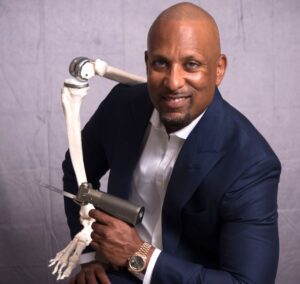
L. Sean Thompson, MD, is a board-certified orthopedic surgeon and Fellow of the American Academy of Orthopaedic Surgeons with more than 17 years of experience in hip and knee replacement, sports medicine, and the treatment of arthritis. He has performed more than 2,000 knee replacements.
Dr. Thompson completed his orthopedic surgery residency at the State University of New York at Stony Brook and his fellowship in adult reconstruction at NYU Hospital for Joint Diseases, one of the country’s leading centers for joint replacement. He later served as an Assistant Professor at NYU Langone, where he mentored orthopedic residents and presented research at national conferences on knee deformity, hip instability, and joint replacement outcomes.
Dr. Thompson is an attending orthopedic surgeon at Northwell Health, where he performs robotic-assisted total knee replacement using the Mako system. He also holds operating privileges at Lenox Hill Hospital, Mount Sinai Queens, and Englewood Hospital, and is a former Lieutenant Commander and Medical Officer in the U.S. Navy Medical Reserve.
Dr. Thompson is fluent in medical Spanish and sees patients at four offices: Manhattan (Park Avenue), Jamaica, Queens, Englewood, NJ, and Clifton, NJ.
Schedule a knee evaluation with Sean Thompson, MD
If knee pain is limiting your daily life and conservative treatment is no longer helping, an orthopedic evaluation can help you understand all of your options, including whether robotic knee replacement is right for you.
Dr. Thompson sees patients at four convenient locations:
- Manhattan: 1045 Park Ave, Ground Floor, New York, NY 10028 · (212) 388-9500
- Queens: 175-61 Hillside Ave,
400, Jamaica, NY 11432 · (718) 291-1300
- Englewood, NJ: 25 Rockwood Pl, Suite 335, Englewood, NJ 07631 · (201) 387-0499
- Clifton, NJ: 777 Passaic Ave,
575, Clifton, NJ 07012 · (201) 387-0499
Book an appointment online or call the office nearest you.
Frequently asked questions
Is robotic knee replacement better than traditional knee replacement?
Not automatically. Robotic assistance can help with planning, implant positioning, and ligament balancing, but both approaches can produce excellent results. The right choice depends on your knee, your health, and your surgeon’s experience.
Does a robot perform the surgery?
No. Your orthopedic surgeon performs the operation and makes every clinical decision. The robotic system provides measurements and guidance during specific steps.
Is recovery faster after robotic knee replacement?
Recovery is generally similar to conventional knee replacement. Your overall health, preoperative strength, and commitment to physical therapy have a major influence on how quickly you recover.
Does robotic knee replacement hurt less?
Some pain is expected after any knee replacement. Pain levels vary from person to person, and robotic assistance alone does not guarantee less pain after surgery.
Which robotic system does Dr. Thompson use?
Dr. Thompson uses the Mako robotic-arm system for total knee replacement at Northwell Health. Before surgery, a CT scan of your knee is used to build a 3D model and a personalized surgical plan.
How long does a knee replacement last?
Modern knee replacements often last many years, and many patients keep their implants for decades. Longevity depends on factors such as activity level, body weight, bone quality, and implant positioning.
Is robotic knee replacement covered by insurance?
Knee replacement is commonly covered when it is medically necessary, but coverage varies by plan. Contact our office and our team can help you understand your coverage.
Can I discuss my care in Spanish?
Yes. Dr. Thompson is fluent in medical Spanish and can discuss your diagnosis and treatment options in Spanish.