| Quick Answer Arthroscopic surgery (arthroscopy) is a minimally invasive procedure in which an orthopedic surgeon uses a pencil-thin camera, called an arthroscope, and small surgical instruments inserted through tiny incisions to diagnose and treat problems inside a joint. It is most commonly performed on the knee, shoulder, and hip and is used to treat issues such as torn cartilage, ligament damage, rotator cuff tears, and impingement. Compared with traditional open surgery, arthroscopy generally involves smaller incisions, less tissue disruption, and a shorter initial recovery—though exact outcomes and healing time depend on the joint, the condition, and the individual patient. |
If you’ve been told you may need “joint surgery” or you’re searching for arthroscopic surgery near me because a doctor mentioned it during a consultation, you probably have a lot of questions. What actually happens during the procedure? How long is recovery? Is it right for your knee, shoulder, or hip problem? This guide walks through what arthroscopic surgery is, how it works for the three most common joints, what to expect before and after, and when to talk to an orthopedic specialist.
Note: This article is for general educational purposes only. It is not a substitute for professional medical advice, diagnosis, or treatment. Only a qualified orthopedic surgeon can determine whether arthroscopy – or any other treatment – is appropriate for your specific condition after a hands-on evaluation.
What Is Arthroscopic Surgery?
Arthroscopic surgery, or arthroscopy, is a minimally invasive surgical technique that lets an orthopedic surgeon look inside a joint and, in many cases, treat the problem in the same procedure – without fully opening the joint. The word itself comes from the Greek “arthro” (joint) and “skopein” (to look), literally meaning “to look at the joint.”
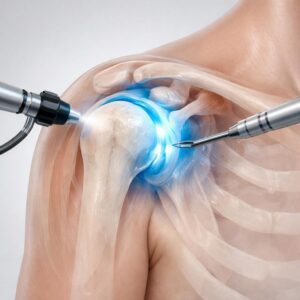
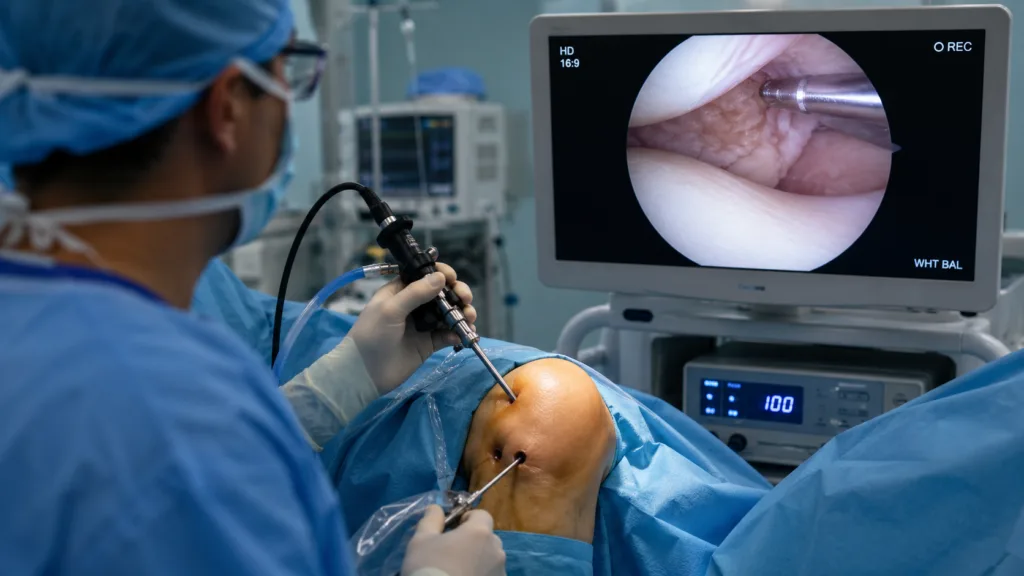
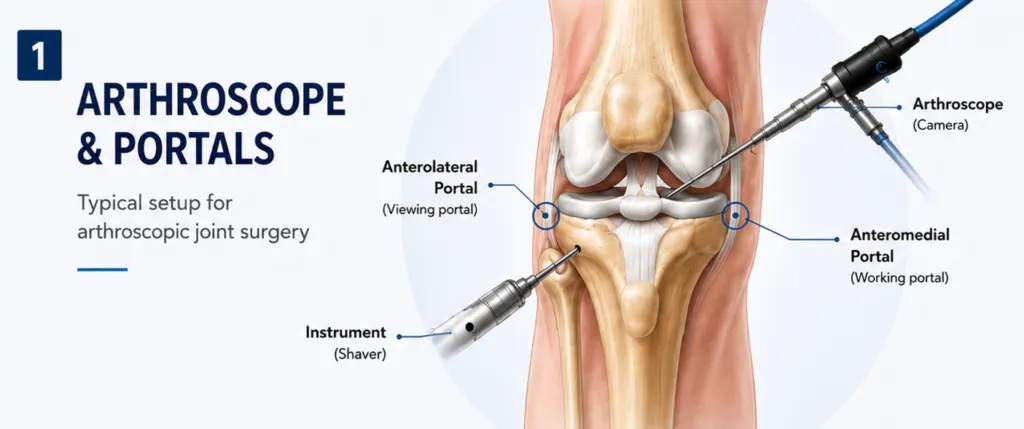
During the procedure, the surgeon inserts an arthroscope – a narrow tube containing a lens, light source, and small camera – through an incision typically less than half an inch long. The camera projects a magnified, high-definition image of the inside of the joint onto a monitor in the operating room. If treatment is needed, the surgeon creates one or two additional small incisions, called portals, and passes miniature surgical instruments through them to repair or remove damaged tissue.
Arthroscopic vs. Open Surgery: What’s the Difference?
Before arthroscopy became widespread, diagnosing and treating joint problems typically required open surgery – a larger incision that fully exposes the joint. Open surgery is still necessary for some complex reconstructions, but for many common joint conditions, arthroscopy offers a less invasive alternative with several potential advantages.
| Factor | Arthroscopic Surgery | Traditional Open Surgery |
|---|---|---|
| Incision size | Several small incisions (¼”–½”) | One larger incision |
| Tissue disruption | Minimal | More extensive |
| Typical setting | Usually outpatient (same-day) | May require a hospital stay |
| Visualization | Magnified camera view | Direct visual access |
| Scarring | Small, often barely visible | More noticeable |
| Suitability | Many common joint conditions | Complex reconstructions, some fractures, joint replacement |
It’s worth noting that arthroscopy does not change the underlying biology of healing – a repaired ligament or cartilage still needs time to heal at its own pace, regardless of how it was accessed. Your orthopedic surgeon is best positioned to determine which approach fits your specific diagnosis.
How Arthroscopic Surgery Works: The Step-by-Step Process
While every procedure is tailored to the joint and condition being treated, most arthroscopic surgeries follow a similar general sequence:
- Anesthesia: Depending on the joint and complexity, patients receive general, regional, or local anesthesia with sedation.
- Joint access: The surgeon makes a small incision and inserts the arthroscope; sterile fluid is used to expand the joint space and improve visibility.
- Diagnostic view: Images from the arthroscope are displayed on a monitor, allowing the surgeon to examine cartilage, ligaments, tendons, and bone surfaces in detail.
- Additional portals: If treatment is needed, one or more small additional incisions are made to accommodate surgical instruments.
- Treatment: The surgeon may trim damaged tissue, repair torn structures, remove loose fragments, or smooth roughened cartilage, depending on the diagnosis.
- Closure and recovery: Incisions are closed with small stitches or adhesive strips and covered with a dressing; the patient is monitored in a recovery area as anesthesia wears off.
Most arthroscopic procedures take between 30 minutes and a little over an hour, though this varies significantly based on what the surgeon finds and needs to treat.
Knee Arthroscopy
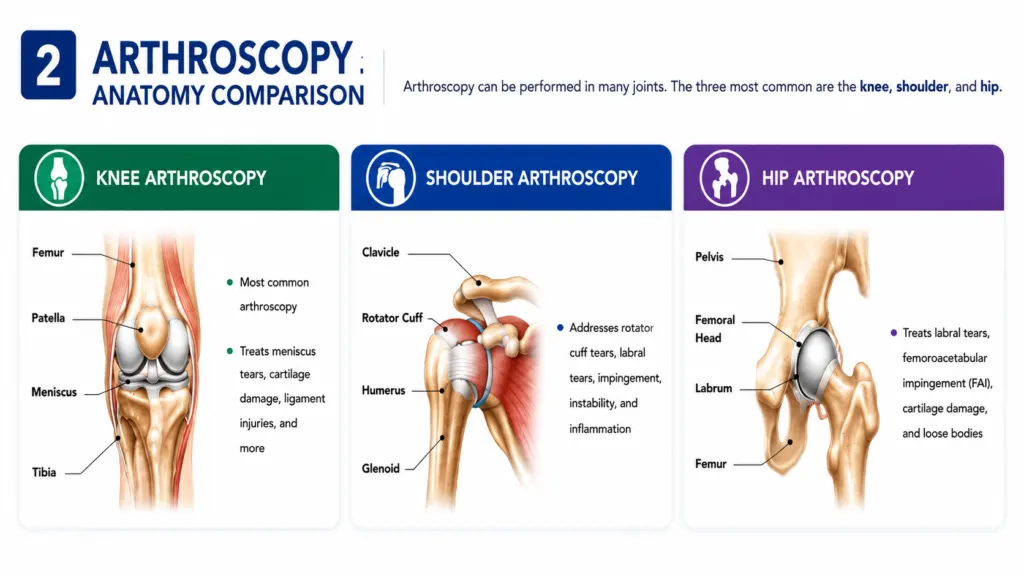
Knee arthroscopy is the most frequently performed type of arthroscopic surgery. It’s commonly used to evaluate and treat pain, swelling, or instability that hasn’t improved with rest, physical therapy, or medication.
Conditions Commonly Treated
- Torn meniscus (cartilage that cushions the knee joint
- Anterior cruciate ligament (ACL) and other ligament injuries
- Loose bone or cartilage fragments within the joint
- Patellar (kneecap) tracking problems
- Synovitis (inflammation of the joint lining)
- Removal of Baker’s cysts or inflamed tissue
Shoulder Arthroscopy
Shoulder arthroscopy is the second most common type of orthopedic arthroscopic procedure. It’s typically considered when shoulder pain, weakness, or limited range of motion persists despite conservative treatment such as physical therapy or anti-inflammatory medication.
Conditions Commonly Treated
- Rotator cuff tears
- Shoulder impingement syndrome
- Labral tears, including SLAP tears
- Shoulder instability or recurrent dislocation
- Frozen shoulder (adhesive capsulitis) that hasn’t responded to nonsurgical care
- Removal of bone spurs or inflamed bursa tissue
Hip Arthroscopy
Hip arthroscopy is less common than knee or shoulder arthroscopy but has become increasingly refined as surgical techniques and imaging have advanced. It’s used to address structural problems deep within the hip joint that are difficult to diagnose without direct visualization.
Conditions Commonly Treated
- Femoroacetabular impingement (FAI), where extra bone causes the hip bones to rub abnormally
- Labral tears (damage to the cartilage rim lining the hip socket)
- Hip dysplasia-related joint irritation
- Loose bodies or cartilage damage within the joint
- Snapping hip syndrome and related soft-tissue conditions
Knee vs. Shoulder vs. Hip Arthroscopy: A Side-by-Side Comparison
| Knee | Shoulder | Hip | |
|---|---|---|---|
| Frequency | Most common | Second most common | Less common, growing |
| Typical anesthesia | General or regional | General, often with a nerve block | General or regional |
| Common conditions | Meniscus tears, ACL injuries | Rotator cuff tears, impingement | FAI, labral tears |
| Initial recovery | Days to a few weeks | For several weeks, a sling is often required | For weeks, crutches often required |
| Return to routine activity. | Roughly 4–6 weeks for many cases | Often several weeks to a few months | Often weeks to a few months |
General ranges based on published patient-education sources; actual recovery depends on the specific procedure performed, tissue healing, and individual health factors. Your surgeon will give you a personalized timeline.
Who Is a Good Candidate for Arthroscopic Surgery?
Arthroscopy isn’t the right choice for every joint problem, and it isn’t typically the first step in treatment. Most orthopedic surgeons recommend trying conservative options – such as rest, physical therapy, anti-inflammatory medication, or injections – before considering surgery, unless there’s an acute injury (like a significant ligament tear) that clearly requires it.
You may be a candidate for an orthopedic evaluation for arthroscopy if you’re experiencing the following:
- Persistent joint pain that hasn’t improved after several weeks of nonsurgical treatment
- Locking, catching, or a sensation of the joint “giving way”
- Swelling that keeps recurring
- Limited range of motion that interferes with daily activities or sport
- A diagnosed structural injury (such as a meniscus or labral tear) confirmed by imaging
| Not sure whether your symptoms warrant arthroscopy? An orthopedic evaluation – including a physical exam and, if needed, imaging – is the only way to know for certain. Schedule a consultation to discuss your specific situation. |
Benefits and Limitations of Arthroscopic Surgery
| Benefits | Limitations |
|---|---|
| Smaller incisions and typically less scarring | Not suitable for every joint condition or fracture pattern |
| Often less post-operative pain than open surgery | Still requires anesthesia and carries surgical risk |
| Frequently performed as outpatient surgery | Healing time for repaired tissue isn’t shortened just because the incision is smaller |
| Magnified visualization can improve diagnostic accuracy | Some complex reconstructions still require open surgery |
| Generally shorter initial recovery than open procedures | Outcomes vary based on the severity of the underlying condition |
Risks and Possible Complications
Arthroscopic surgery is generally considered safe, and serious complications are uncommon. Published outcomes research on knee and shoulder arthroscopy has found overall serious-complication rates of roughly 1% to just over 1%, though rates vary by procedure type, patient age, and overall health. As with any surgery, potential risks include:
- Infection at the incision site or within the joint
- Blood clots (deep vein thrombosis or pulmonary embolism)
- Nerve or blood vessel irritation or injury
- Stiffness, swelling, or persistent pain
- Instrument breakage or incomplete repair requiring further treatment
- Anesthesia-related risks
Your individual risk depends on factors such as age, overall health, the joint involved, and the complexity of the procedure. Your surgeon will review your personal risk profile during your consultation and answer any questions you have before you consent to surgery.
How to Prepare for Arthroscopic Surgery
Preparation typically begins with a consultation where your surgeon reviews your medical history, current medications, and imaging results. In the days and weeks leading up to surgery, you’ll usually be asked to:
Patient Preparation Checklist
- Complete any required pre-operative testing (bloodwork, imaging, or medical clearance)
- Share a full list of medications and supplements with your care team, including any blood thinners
- Follow instructions about fasting the night before surgery
- Arrange for someone to drive you home, since anesthesia affects your ability to drive
- Prepare your home for recovery – such as setting up ice packs, crutches, or a sling, and clearing walkways
- Ask about pausing certain medications (only under your doctor’s guidance)
- Confirm post-operative physical therapy arrangements in advance
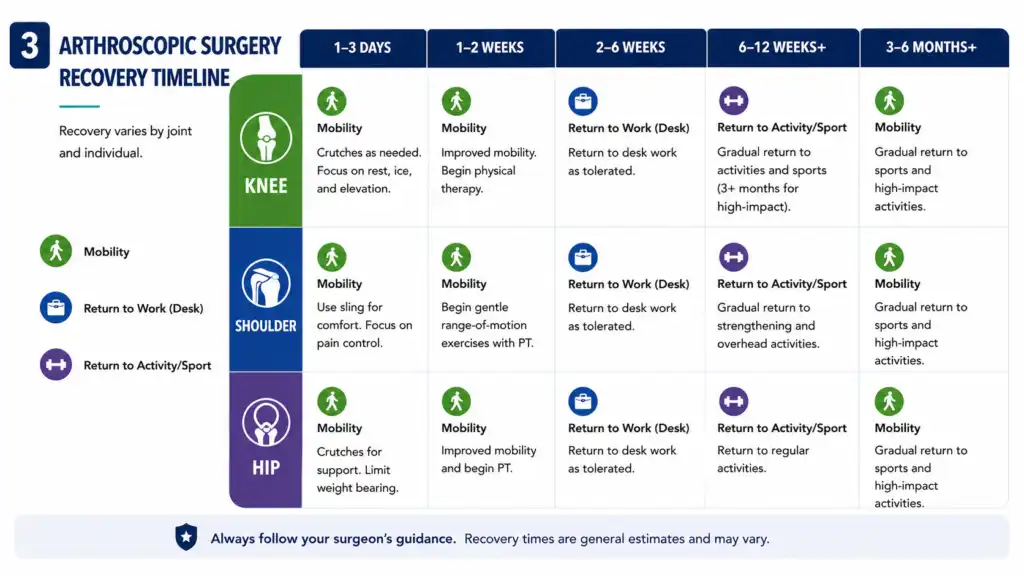
Recovery Timeline After Arthroscopic Surgery
Recovery from arthroscopic surgery happens in phases, and the pace depends heavily on which joint was treated and how extensive the repair was. The timeline below reflects general patterns reported in patient-education literature – your surgeon’s guidance for your specific procedure always takes priority.
| Phase | Knee | Shoulder | Hip |
|---|---|---|---|
| First 48–72 hours | Rest, ice, elevation, and limited weight-bearing | Sling use begins; ice and rest | Rest, crutches typically needed |
| 1–2 weeks | Light activity, early PT, often begins | Gentle passive-motion exercises | Protected weight-bearing, early PT |
| 3–6 weeks | Many resumes highlight daily activities | Sling often discontinued; active PT increases | Crutches often reduced; PT intensifies |
| 2–4 months | Return to sport possible for some cases | Continued strengthening; return to overhead activity varies | Continued strengthening; gradual return to activity |
| Beyond 4 months | Full recovery for complex repairs (e.g., ACL) | Full strength may take up to 6–12 months for repairs | Full recovery for complex repairs can extend to 6+ months |
These ranges are general guidelines, not guarantees. Recovery from ligament reconstruction, rotator cuff repair, or labral repair generally takes longer than a simple diagnostic arthroscopy or minor cartilage trim.
Rehabilitation and Physical Therapy
Physical therapy plays a central role in recovering full function after arthroscopic surgery. A structured rehab program typically progresses through stages:
- Protection and pain control: Managing swelling and protecting the healing tissue in the first days after surgery.
- Restoring range of motion: Gentle, guided exercises to prevent stiffness while respecting healing timelines.
- Rebuilding strength: Progressive strengthening exercises targeting the muscles that support the joint.
- Functional and sport-specific training: Gradually reintroducing daily activities, work tasks, or sport-specific movement patterns.
Skipping or rushing physical therapy is one of the most common reasons patients experience lingering stiffness or reduced function after arthroscopy. Following your therapist’s plan – even once symptoms improve – matters as much as the surgery itself.
Expected Outcomes
Outcomes after arthroscopic surgery vary by procedure and patient. Published research generally reports favorable results for common procedures – for example, studies on meniscus surgery and rotator cuff repair often report improvement in the large majority of patients – but results depend on the severity of the underlying damage, tissue quality, age, activity level, and adherence to rehabilitation. No surgeon can guarantee a specific outcome or recovery timeline for any individual patient; outcomes should always be discussed in the context of your personal diagnosis.
Myths vs. Facts About Arthroscopic Surgery
| Myth | Fact |
|---|---|
| “Arthroscopy means there’s basically no recovery time.” | Smaller incisions can mean less initial pain, but the repaired tissue still needs its normal healing time – recovery can still take weeks to months. |
| “Arthroscopic surgery uses lasers.” | Most arthroscopic procedures use mechanical instruments, not lasers; lasers offer limited benefit and are rarely used today. |
| “If I have arthroscopy, I’ll never need open surgery.” | In some cases, a surgeon may discover during the procedure that open surgery is needed to fully address the problem. |
| “Arthroscopy is only for athletes.” | It’s used across a wide range of patients and ages to treat everyday wear-and-tear injuries, not just sports injuries. |
| “Any orthopedic surgeon can perform any arthroscopic procedure equally well.” | Outcomes are associated with surgeon experience and procedure volume, which is worth asking about during your consultation. |
When Should You Seek an Orthopedic Evaluation?
You don’t need to have already tried every other treatment before talking to a specialist. Consider scheduling an orthopedic evaluation if you have:
- Joint pain lasting more than a few weeks despite rest and home care
- A recent injury with swelling, instability, or an inability to bear weight
- A popping or tearing sensation at the time of injury
- Recurring episodes of the joint locking or giving way
- Pain that limits your ability to work, exercise, or sleep
An orthopedic surgeon can perform a physical exam, review imaging if needed, and discuss whether arthroscopy – or a nonsurgical approach – is the most appropriate next step for your specific situation.
Key Takeaways
| Key Takeaways: Arthroscopic surgery uses a small camera and instruments to diagnose and treat joint problems through tiny incisions. It’s most commonly performed on the knee, shoulder, and hip, each with its own set of typical conditions and recovery expectations. Recovery timelines range from a few weeks to several months depending on the procedure and the individual. Serious complications are uncommon but possible, and risk varies by patient and procedure. The best way to know if arthroscopy is right for you is a personalized evaluation with an orthopedic specialist. |
Frequently Asked Questions
Is arthroscopic surgery painful?
Patients are under anesthesia during the procedure and don’t feel pain while it’s happening. Afterward, some soreness at the incision sites and within the joint is normal and is usually manageable with the pain-control plan your surgeon provides.
How long does arthroscopic surgery take?
Most procedures take roughly 30 minutes to a little over an hour, though the exact time depends on what the surgeon finds and needs to treat during the operation.
Will I need physical therapy after arthroscopy?
Most patients benefit from a structured physical therapy program after arthroscopic surgery to restore motion, strength, and function. Your surgeon will outline a rehabilitation plan specific to your procedure.
How do I find arthroscopic surgery near me?
Start with a referral from your primary care physician or search for a board-certified orthopedic surgeon who specializes in the joint involved. During your first consultation, it’s reasonable to ask about the surgeon’s experience with your specific condition and procedure.
Is arthroscopic surgery covered by insurance?
Coverage varies by insurer, plan, and medical necessity criteria. Contact your insurance provider directly, or ask the clinic’s billing team to help verify your specific coverage before scheduling surgery.
Can arthroscopic surgery fail or need to be repeated?
As with any surgery, outcomes aren’t guaranteed. Some patients may need additional treatment if symptoms persist or if the initial repair doesn’t fully resolve the underlying problem. Discussing realistic expectations with your surgeon beforehand is important.
Ready to Learn if Arthroscopic Surgery Is Right for You?
Arthroscopic surgery has changed how orthopedic surgeons diagnose and treat many common knee, shoulder, and hip conditions – offering a minimally invasive option for patients who haven’t found relief through conservative care. But it isn’t a one-size-fits-all answer, and the right treatment plan depends entirely on your specific diagnosis, health history, and goals.
If you’ve been dealing with persistent joint pain, instability, or an injury that isn’t improving, the most reliable next step is a personalized evaluation with an orthopedic specialist. Schedule a consultation today to discuss your symptoms, review your options – surgical and nonsurgical – and take the next step toward getting back to the activities you enjoy.
This article is provided for general informational purposes and does not constitute medical advice. Always consult a qualified healthcare professional regarding your individual condition and treatment options.